
Complete Guide to Avoiding Legal Disasters & Understanding Why Your Business Needs a Legal Health Checkup
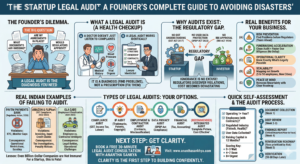
- THE FOUNDER’S DILEMMA
You’ve built something remarkable. Your startup is 18 months old, revenue is growing, and you’re ready to hire your first team. Then an investor shows interest. Excitement turns to anxiety when they ask:
“Can you provide an independent legal audit proving your company is compliant?”
Your stomach sinks. You’ve been so focused on building that you never stopped to check if you’re building legally. You don’t know:
- What documents you’re missing ?
- What agreements need to be in place ?
- Whether regulatory bodies would approve of how you’re operating?
This moment defines many founders. Some rush to fix problems reactively and expensively. Others realize they should have done this proactively from day one.
This guide walks you through:
- What a legal audit actually is?
- Why it matters?
- How to approach it?
Your business depends on understanding this.
———————————————————————————————————————–
- UNDERSTANDING LEGAL AUDITS: WHAT IT IS AND ISN’T
A legal audit is a comprehensive review of your company’s legal compliance and structural integrity.
| Health Checkup | Legal Audit |
| A doctor doesn’t just listen to your complaints. They take your:
· Blood pressure · Run blood tests · Examine your medical history · Check your organs and |
A legal audit works identically. It systematically examines multiple areas of your business:
· How you’re structured under company law · Who owns what · How you manage people · What agreements you have · Whether you’re following tax and regulatory laws and |
| Provides a complete health report – Your heart is healthy, but your cholesterol is elevated. Here’s what you need to do. | Provides a clear report – Here’s what’s working, here’s what’s broken, and here’s what needs immediate attention |
The key point: An audit is a diagnosis, not a prescription. It identifies problems. You then decide how to fix them with professional help.
———————————————————————————————————————–
- WHY LEGAL AUDITS EXIST: THE REGULATORY GAP
Governments, regulators, and investors realized a critical gap: Most of the companies unknowingly break laws every single day.
- A delivery startup operates without understanding GST compliance under the GST Act 2017.
- A SaaS company collects user data without proper data protection agreements required by the Digital Personal Data Protection Act 2023 (DPDP Act).
- A fintech startup processes payments without realizing RBI requires specific approvals under the RBI Act 1934.
None of this is intentional—it’s ignorance of regulatory requirements. By the time regulators discover these violations, the cost becomes devastating.
- Corrective action notices get issued
- Fines are imposed
- Operations get restricted and
- Founders face personal liability.
The concept of legal audit exists to bridge this gap. It’s a preventive measure—find problems before they become legal disasters. Regulators encourage it. Investors demand it. Smart founders do it proactively before someone forces them to do it reactively.
———————————————————————————————————————–
- REAL BENEFITS FOR YOUR BUSINESS
- Risk Prevention: A legal audit identifies problems months or years before regulators do. Instead of facing a surprise government notice, you discover issues on your timeline and fix them when it’s still affordable.
- Fundraising Acceleration: Investors conduct legal due diligence before funding. Having a clean audit report eliminates delays. Many startups face 3-6 month fundraising delays because investors uncover legal issues during their own review under SEBI regulations for private placements. An early audit prevents this entirely.
- Operational Clarity: You know exactly what’s legally possible and what’s not under the relevant Acts. This clarity enables confident decision-making about hiring (covered under Labour Code 2020), partnerships, expansion, and product launches (covered under industry-specific regulations).
- Scalability: As you grow, legal complexity multiplies. An audit maps out everything that needs to be in place before you scale from 5 employees to 50 (employment law under Labour Code 2020, sections on wages and benefits), or from one city to five cities (GST registration, state-specific compliance).
- Peace of Mind: Most founders operate with background anxiety about legal issues they don’t understand. An audit removes this uncertainty. You either discover you’re fine (confidence boost), or you discover issues with a clear roadmap to fix them (actionable clarity).
———————————————————————————————————————–
- WHAT HAPPENS WHEN YOU SKIP IT: REAL INDIAN EXAMPLES
Let me show you what actually happens when founders ignore legal audits.
Example 1: Paytm Payments Bank Limited (Regulatory Action, 2024)
- What happened: Paytm Payments Bank Limited, one of India’s largest digital payment platforms, faced regulatory action from the Reserve Bank of India for compliance violations.
- The violations: The company had gaps in Know Your Customer (KYC) procedures, deficient transaction monitoring systems, and non-compliance with specific regulatory guidelines for digital payment entities under the RBI Act 1934 and Payment Systems Regulations.
- The consequence: RBI issued enforcement action with operational restrictions and regulatory scrutiny. The company had to implement comprehensive compliance overhauls, affecting operations and reputation.
- The lesson: Even billion-dollar companies face regulatory action when compliance isn’t proactively audited. For a startup, this would have been fatal.
Example 2: Amazon India & Flipkart (GST Compliance Challenges, 2022-2023)
- What happened: India’s largest e-commerce companies faced GST (Goods and Services Tax) compliance issues during their scaling phase.
- The violations: Incorrect GST classification of goods, invoicing discrepancies, and input credit claim issues across multiple product categories, violating Sections 143-144 of the GST Act 2017 (provisions on examination of records and determination of liability).
- The consequence: Both companies faced tax department investigations, compliance notices under Sections 122-140 of GST Act 2017 (penalty provisions), and operational adjustments. They had to implement corrective actions across their systems.
- The lesson: Scale without legal clarity, and you’ll spend more time fixing compliance issues than growing. A legal audit upfront could have prevented millions in remediation costs.
Example 3: Ola Cabs (Employment Classification Challenges, 2020-2023)
- What happened: Ola Cabs faced legal challenges across multiple states regarding the classification of drivers are they employees or independent contractors?
- The violations: The employment relationship structure didn’t align with state labor laws, creating ambiguity about driver protections, benefits, and wage regulations required under the Labour Code 2020 (Code on Wages, Code on Social Security, and Code on Occupational Safety, Health and Working Conditions).
- The consequence: The company faced legal battles in multiple jurisdictions, operational challenges in different states, and compliance uncertainty that slowed expansion.
- The lesson: When you scale rapidly without clarifying employment relationships legally under applicable labor codes, you create expensive conflicts that could have been prevented with one audit conversation at the beginning.
———————————————————————————————————————–
- WHEN IS A LEGAL AUDIT MANDATORY?
When it’s legally required:
- Raising institutional funding – SEBI (Securities and Exchange Board of India) regulations for private placements and venture funding expect founders raising equity to demonstrate legal compliance.
- Operating in regulated industries – Fintech companies need RBI approvals under RBI Act 1934, healthcare startups need DGMS/state board approvals, insurance-related businesses need IRDAI approvals.
- Processing customer data – If you collect, store, or process personal data (which almost every startup does), the Digital Personal Data Protection Act 2023 (DPDP Act), Sections 8-20 (on data fiduciary obligations) requires proper data protection agreements and security measures.
- Significant debt or loans – Banks often require legal audits before disbursing significant loans to ensure the company can legally obligate itself under the Companies Act 2013, Sections 179-183 (on borrowing powers).
- Planning M&A (Mergers/Acquisitions) – Acquirers conduct extensive legal due diligence. Having your own audit prevents surprises during this critical process under the Companies Act 2013, Sections 391-394 (on schemes of merger and compromise).
When it’s highly recommended (not legally required, but practically essential):
- You’ve been operating 1+ year and have never had a legal review
- You have employees (employment law compliance under Labour Code 2020 is complex and frequently violated)
- You’re in a regulated industry (fintech, healthcare, data-intensive, etc.)
- You process user data of any kind
- You’re scaling rapidly (hiring, entering new markets, new product lines)
- You’re planning to fundraise within 12 months
Bottom line: While governments don’t mandate audits for every startup, investors will demand them, and smart founders do them proactively. The choice is between doing it on your timeline or someone else’s timeline—and someone else’s timeline is always more expensive and stressful.
———————————————————————————————————————–
- TYPES OF LEGAL AUDITS: UNDERSTANDING YOUR OPTIONS
Legal audits come in different varieties depending on your specific needs. You don’t need all of them—you need the ones relevant to your situation.
- Compliance Audit – Checks whether you’re following all applicable laws:
- GST compliance under GST Act 2017 (Sections 122-140)
- Income tax filing under Income Tax Act 1961
- Labor law compliance under Labour Code 2020
- Industry-specific regulations. Most critical for businesses operating in multiple jurisdictions.
- IP (Intellectual Property) Audit – Verifies that your trademarks, patents, copyrights, and trade secrets are properly registered under Patents Act 1970, Trademarks Act 1999, and Copyright Act 1957, and legally owned by your company (not by founders personally). Essential for any tech company, SaaS, or companies with proprietary processes.
- Employment & Contractor Audit – Reviews all employment contracts and contractor agreements and ensures proper classification of workers under Labour Code 2020 (Code on Wages, Code on Social Security). Prevents expensive disputes when employees leave or when regulators investigate wage/benefit violations under Sections 14-21 of Code on Wages.
- Contract Audit – Examines all customer contracts, supplier agreements, partnership agreements, and terms of service to ensure they’re protecting your company and not creating hidden liabilities under the Indian Contract Act 1872.
- Data Privacy Audit – Ensures you’re compliant with DPDP Act 2023, specifically Sections 8-20 (on data fiduciary obligations), have proper data protection agreements with vendors, and can prove that user data is collected, stored, and processed legally.
- Financial Audit – Reviews accounting practices, tax filings, and financial record-keeping to ensure compliance with tax laws and accounting standards under the Companies Act 2013 (Sections 92-93 on financial reporting), and Income Tax Act 1961.
- Integrated Audit – Combines all of the above into one comprehensive review. Most startups need this rather than separate audits.
Most startups benefit from an Integrated Audit rather than multiple separate audits. It’s more cost-effective, provides a complete picture, and identifies how different compliance areas connect.
———————————————————————————————————————-
- BEFORE YOU DECIDE: QUICK SELF-ASSESSMENT
Before booking an audit, honestly assess your situation. This helps you determine if you need one now or can wait a few months.
- Stage & Structure Questions:
- Are you pre-seed, seed-funded, or Series A+?
- How many founders do you have, and do you have written founder agreements?
- Have you been operating for 1+ year without ever having a legal review?
- People & Employment Questions:
- Do you have employees? Do they have written employment contracts compliant with Labour Code 2020?
- Do you have contractors? Are they properly classified (not misclassified as employees under Section 2(a) of Code on Wages)?
- Do you have proper employee agreements covering IP ownership, confidentiality, and non-compete clauses?
- Regulatory & Compliance Questions:
- Are you in a regulated industry (fintech, healthcare, data-intensive, etc.)?
- Do you collect, store, or process any user data or customer information under DPDP Act 2023?
- Do you operate across multiple states or countries (triggering multi-jurisdictional compliance)?
- IP & Asset Questions:
- Is your core technology/product legally owned by the company under Patents Act 1970, Trade Marks Act 1999, or Copyright Act 1957, or is there ambiguity?
- Have you filed trademarks for your brand name?
- Do you use any licensed technology or third-party code that needs formal agreements?
- Funding & Growth Questions:
- Are you planning to raise capital within the next 12 months?
- Have you received investor interest that requires legal due diligence?
- Are you scaling rapidly (entering new markets, new product lines, major hires)?
- Scoring:
- 0-3 checked: You can likely wait 3-6 months, but start documenting properly now
- 4-7 checked: You should schedule an audit within the next 2-3 months
- 8+ checked: You need an audit urgently—this week if possible
———————————————————————————————————————–
- HOW THE AUDIT PROCESS ACTUALLY WORKS
Legal audits aren’t mysterious or disruptive. Here’s exactly what happens.
- Week 1 – Document Collection: You provide documents (incorporation certificates under Companies Act 2013, founder agreements, employment contracts under Labour Code 2020, customer agreements, tax filings, financial records, board minutes if applicable). The auditor creates a checklist of what’s needed and what’s missing.
- Week 2-3 – Deep Review: The auditor reviews everything systematically. They’re looking for: proper documentation per Companies Act 2013, Sections 88-91 (statutory records); compliance gaps in GST Act 2017, Labour Code 2020, DPDP Act 2023; conflicting agreements; missing signatures; outdated terms; regulatory violations; and structural issues. They make detailed notes on what’s working and what isn’t.
- Week 4 – Findings Report: You receive a report in plain language (not legal jargon). It categorizes findings as: Critical (fix immediately to avoid penalties under Sections 122-140 of GST Act or similar); Important (fix within 30 days to avoid regulatory warnings); and Nice-to-have (fix when convenient for operational efficiency).
- Week 5 – Remediation Roadmap: The auditor walks you through the roadmap: which issues to fix first (usually regulatory compliance and IP ownership), estimated cost for each fix, realistic timeline, and who needs to do what.
Total timeline: 4-5 weeks from start to actionable roadmap. Minimal disruption to your operations. You get clear, prioritized guidance.
After the audit: You implement fixes (typically 30-90 days depending on complexity), then do a follow-up verification to confirm problems are solved and you’re in compliance with applicable Acts.
———————————————————————————————————————–
- REGULATORY FRAMEWORK AND APPLICABLE SECTIONS
If legal problems are found, which laws apply and which regulatory bodies enforce them?
- GST Compliance – Governed by GST Act 2017. Administered by CBIC (Central Board of Indirect Taxes and Customs).
- Issues: Incorrect tax classification, invoicing errors, input credit claims.
- Penalties: Sections 122-140 of GST Act 2017 provide penalties ranging from denial of input credit to financial penalties plus interest depending on severity and whether violation was intentional.
- Income Tax & Corporate Tax – Governed by Income Tax Act 1961 and Companies Act 2013. Administered by Income Tax Department.
- Issues: Incorrect business structure, improper expense categorization, tax filing delays.
- Penalties: Sections 270A, 271B, 271C, 271D of Income Tax Act provide penalties for various violations.
- Employment & Labor – Governed by Labour Code 2020 (which consolidated previous labor laws into four codes). Administered by State Labour Departments.
- Issues: Employee misclassification under Section 2(a) of Code on Wages, wage violations under Sections 4-5, missing benefits under Code on Social Security, improper contracts under Code on Occupational Safety.
- Penalties: Sections 205-208 of Labour Code provide penalties for violations.
- Data Privacy – Governed by Digital Personal Data Protection Act (DPDP) Act 2023. Administered by Data Protection Board (to be established).
- Issues: Unauthorized data collection under Section 8, missing consent under Section 6, insecure storage, improper third-party sharing under Section 7.
- Penalties: Sections 25-29 of DPDP Act 2023 provide penalties ranging based on violation severity.
- Payment Processing (Fintech) – Governed by RBI Act 1934 and Payment Systems Act. Administered by Reserve Bank of India.
- Issues: Operating without approval under Section 10 of Payment Systems Regulations, KYC violations under RBI KYC guidelines, transaction monitoring gaps.
- Penalties: RBI enforces through corrective action framework and monetary penalties.
- Corporate Compliance – Governed by Companies Act 2013. Administered by MCA (Ministry of Corporate Affairs).
- Issues: Improper incorporation under Sections 7-8, missing board meetings under Section 173, unclear ownership structure under Sections 88-91, director disqualifications under Section 274.
- Penalties: Sections 450-455 of Companies Act 2013 provide penalties and director disqualifications.
- Intellectual Property – Governed by Patents Act 1970, Trade Marks Act 1999, Copyright Act 1957. Administered by IP Office and State IP Departments.
- Issues: Unregistered trademarks under Sections 22-28 of Trade Marks Act, unclear IP ownership under Copyright Act provisions, unlicensed use of third-party IP.
- Penalties: Infringement provisions in each Act provide for damages, injunctions, and criminal penalties.
Enforcement approach: Penalties vary widely depending on severity, history, and circumstances. Rather than citing specific amounts (which vary by case), understand that regulatory violations typically result in: corrective action notices, fines, operational restrictions, and in severe cases, business shutdown or director disqualification under the respective Acts.
———————————————————————————————————————–
- WHAT TO DO IF PROBLEMS ARE FOUND
Discovering legal problems during an audit feels concerning. But here’s the truth: finding problems during an audit is infinitely better than having regulators find them.
- Step 1 – Prioritize: Not all problems are equally urgent. Your audit report will categorize them.
- Critical issues (regulatory violations that could trigger enforcement action under Sections 122-140 of GST Act, or similar provisions in other Acts) go first.
- Important issues (structural problems that affect operations) go second.
- Nice-to-have issues (documentation that makes life easier) go last.
- Step 2 – Create Implementation Timeline:
- Some fixes take 2 weeks (signing employment contracts under Labour Code 2020).
- Others take 2 months (restructuring your business entity for tax optimization under Companies Act 2013, Sections 2-3). Your auditor will provide realistic timelines for each fix.
- Step 3 – Allocate Budget: Fixes have costs.
- Simple fixes (creating and signing standard contracts) cost ₹5-15k.
- Medium fixes (GST registration under GST Act 2017, business restructuring) cost ₹20-50k.
- Complex fixes (entity restructuring under Companies Act 2013, compliance overhaul) cost ₹50-150k+. Plan your budget accordingly.
- Step 4 – Execute: Implement fixes with professional help where needed. Document everything. Keep records of what was fixed, when, and how, to demonstrate good faith compliance.
- Step 5 – Verify: 30-60 days after fixing, get a follow-up verification to confirm problems are actually solved. Get an updated audit report showing compliance with applicable Acts.
- Step 6 – You’re Ready: For fundraising, for scaling, for regulatory scrutiny. With confidence.
The whole process—from discovering problems to fixing them to verification—typically takes 60-120 days depending on complexity. That’s a small investment compared to years of operating with hidden legal liability.
———————————————————————————————————————–
- WHY THIS MATTERS: WHAT WE OBSERVE IN STARTUPS
Here’s what we see in startups:
- Startups that got audited early:
- Raised capital faster (no legal surprises during investor due diligence).
- Scaled confidently (knew their compliance baseline before hiring and expanding under Labour Code 2020 and other employment laws).
- Avoided regulatory penalties (fixed issues before anyone noticed enforcement under GST Act, DPDP Act, etc.).
- Moved faster overall (founders didn’t waste time worrying about legal risks).
- Startups that skipped audits:
- Faced 3-6 month fundraising delays (had to fix problems during investor review).
- Hit regulatory penalties (caught by government agencies enforcing GST Act, Labour Code, DPDP Act, etc.).
- Lost momentum (spent months fixing what could’ve been prevented in weeks).
- Founders lived with background stress (not knowing if they were legally compliant with companies law, tax law, employment law).
- The financial reality:
- A legal audit costs ₹1-3 lakhs (one-time investment).
- The problems it prevents cost ₹20-100 lakhs or more.
- Every founder who gets an early audit wishes they’d done it sooner.
- Every founder who skips it regrets it later.
———————————————————————————————————————–
- WHERE YOU STAND NOW: THE DECISION
You now understand what a legal audit is, why it exists, what it covers, and why it matters. You know about the regulatory framework under Companies Act 2013, GST Act 2017, Labour Code 2020, DPDP Act 2023, and other applicable laws. You know what happens when you skip it.
Here’s where you likely stand:
- Just starting, pre-seed stage? Document everything properly now per Companies Act 2013 requirements. Schedule an audit for 6 months in.
- Seed-funded or raising capital soon? Get an audit NOW, before talking to investors. This prevents surprises that kill deals. Investors expect clean compliance per SEBI regulations.
- Operating 1-2 years with employees? Get an audit NOW. You likely have issues to fix under Labour Code 2020 and other employment regulations, and the sooner you fix them, the better.
- In a regulated industry (fintech, healthcare, data)? Get an audit THIS WEEK. No delay. Regulatory violations under RBI Act 1934, DPDP Act 2023, etc., are serious.
- Scaling rapidly? Get an audit NOW, before complexity multiplies under multiple states’ labour laws, GST registration requirements, and other jurisdictions. Complexity becomes exponentially harder to untangle.
The cost of an audit is fixed and affordable. The cost of legal problems is unlimited and devastating. Most founders understand this only after their first legal crisis. Don’t be that founder.
———————————————————————————————————————–
- NEXT STEP: GET CLARITY ON YOUR SPECIFIC SITUATION
You now have the knowledge. The next step is getting a clear assessment of YOUR startup’s specific legal position.
Book a free 30-minute legal audit consultation with Anantha Sankya.
Visit: www.ananthasankhya.com
In this consultation, we’ll:
- Understand your startup’s stage, industry, and structure
- Do a quick assessment of your legal compliance position
- Show you exactly what legal risks you’re facing (or confirm you’re fine)
- Tell you if you need a full audit immediately or can wait a few months
- Provide honest guidance with no pressure to buy anything
What typically happens:
- Some founders discover they’re at significant risk and book an audit immediately
- Some discover they’re actually well-positioned and only need minor fixes
- Some discover they need an audit before raising capital
Either way, you’ll have clarity. And clarity is the first step to building confidently.
ABOUT ANANTHA SANKYA
We help startups and growing businesses understand their legal position and implement sustainable compliance. We believe that legal clarity is the foundation of confident scaling. If you’d like to discuss your specific situation, we’re here to help.